PART 1
“Take her to her grandmother’s ranch before she dies here and leaves us smelling like medicine,” said Doña Carmen, as if she were talking about an old piece of furniture.
Ricardo lowered his gaze. He was almost forty, but in front of his mother he still looked like a scolded child. In the living room of that apartment in the Portales neighborhood, Mariana sat in a wheelchair, a blanket over her legs, her eyes wide with terror.
She couldn’t speak. She couldn’t move her hands properly. Just three weeks ago, the doctor had said she’d suffered a stroke. He’d also said, in a grave voice, that her heart was weak and that she might not last much longer.
Doña Carmen didn’t cry when she heard that. The first thing she asked was:
—And when will your grandmother’s inheritance be paid?
Thirty-year-old Mariana had received a letter months earlier from Guadalajara: a great-aunt who lived there had left her money, a plot of land, and an old house in a town in Michoacán. Naively, she told Ricardo, believing they could finally get ahead. He hugged her, kissed her forehead, and that night even ordered pozole to celebrate.
But everything changed too quickly.
Before she got sick, Mariana was an administrative assistant at an import company. She dreamed of opening her own business, saving money, buying a house far away from Doña Carmen, and living in peace. Ricardo always said he wanted to start his own business too, though he never went beyond complaining about his job at an insurance company.
Doña Carmen hated Mariana’s ambitions.
—A decent wife takes care of her husband, she doesn’t go around playing at being a businesswoman—she would repeat to him.
When Mariana became immobile, her mother-in-law stopped pretending. She forgot to feed her, changed her clothes with annoyance, and spoke to her as if she didn’t understand.
—Just look at you. All that bragging about your plans and you ended up like this.
That morning, Ricardo carried the suitcases to the car. The elevator wasn’t working, so he carried everything down from the fifth floor, sweating and cursing.
A neighbor looked out.
—Are you going on a trip?
Doña Carmen smiled with a false sweetness.
—To rehabilitation, neighbor. Even if it costs a lot, we’re not going to abandon our Marianita.
When the door closed, the old woman spat:
—Hurry up before someone asks questions.
Ricardo helped Mariana into the back seat. She looked at him with tears in her eyes, searching for a sign of remorse. He fastened her seatbelt without meeting her gaze.
—Listen, Mariana. My mother is getting old. I work. You’ll be better off there. It’s your homeland, isn’t it?
She wanted to scream no. That an abandoned house wasn’t a clinic. That a sick woman didn’t leave herself with a stranger. That he was her husband.
But his mouth would not obey.
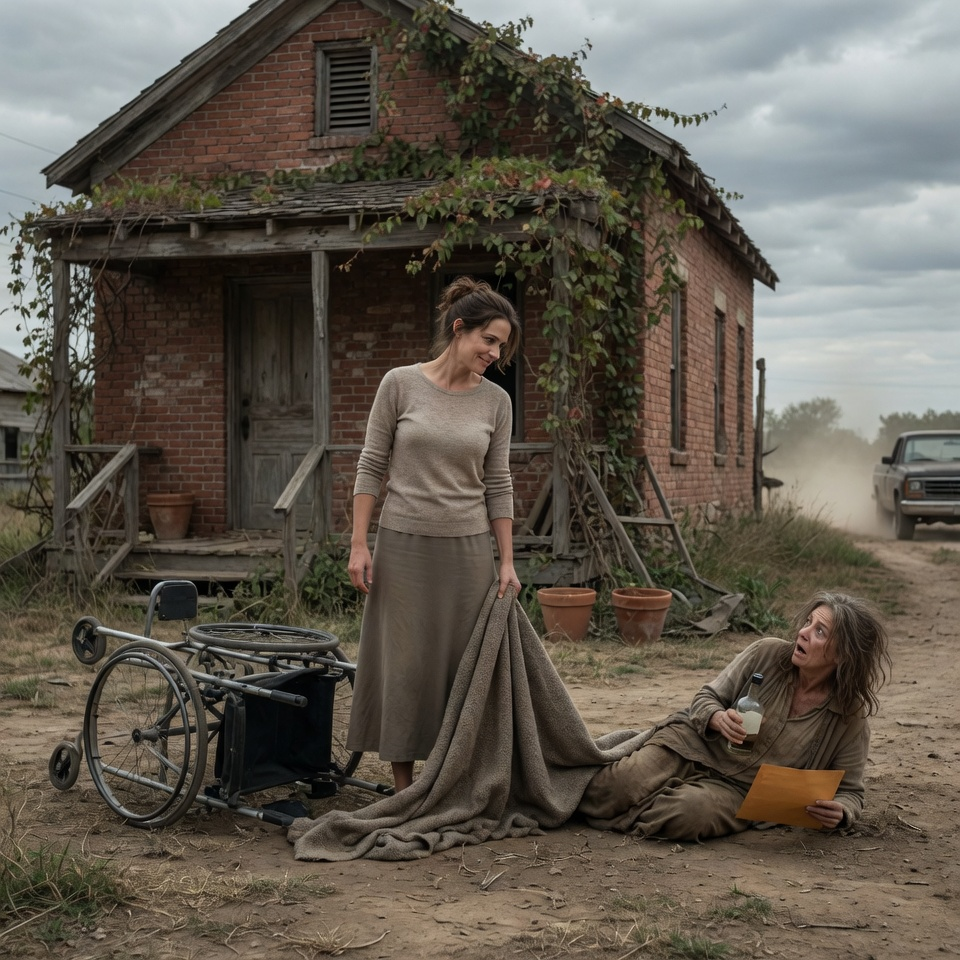
The journey lasted for hours. They arrived at a nearly deserted village, with dusty streets, adobe houses, and dogs asleep under the trees. Grandma’s house was behind a fallen fence, its yard overgrown with dry grass.
On the patio bench slept a disheveled woman, with a stained blouse and smelling of alcohol.
—Glory! —Ricardo shouted.
The woman woke up staggering.
—Oh, young man, I thought you were coming tomorrow.
Ricardo pointed at Mariana.
—She’s my wife. You’re going to feed her, give her her medicine, and… well, clean her up. I pay you every month.
Gloria smiled when she saw the envelope with banknotes.
Mariana felt like her world was breaking apart. Her husband was handing her over to a drunk woman.
Ricardo bowed down in front of her.
—Don’t make that face. The air is clean here. You might even recover.
Then he got in the car and left.
Mariana stood motionless in the middle of the patio, with Gloria behind the chair and the abandoned house in front of her.
But when the car disappeared down the road, Mariana took a deep breath, threw back the blanket, and stood up.
Gloria opened her mouth, horrified.
—Didn’t you say I was paralyzed?
Mariana looked at her coldly and took several bills from the hidden pocket of her sweater.
—Let’s make a deal. You tell Ricardo that I’m still the same, that he doesn’t need to come. In return, I’ll pay you more than him.
Gloria took the money without asking.
That same afternoon, Mariana dialed from a cell phone that Doña Carmen had not found.
—Laura… it happened exactly as you said. They brought me to the village. Yes, they abandoned me.
On the other side, her best friend remained silent for a few seconds.
—Then there’s no doubt, Mariana. Now begins what they never imagined.
And nobody could believe what was about to happen…
PART 2
Laura arrived that night from Mexico City with two suitcases, food, documents, and a bottle of wine.
Upon seeing the wheelchair at the entrance, he angrily kicked it.
—Three weeks pretending to be trapped there. Was it worth it?
Mariana sat down in an old, dusty armchair. She had dark circles under her eyes, but her gaze was steady.
—I needed to know how far they were capable of going.
It had all started before the alleged spill.
A month after receiving the inheritance letter, Mariana saw Ricardo in Plaza Universidad. She was going to buy him a tie. But he appeared holding hands with a twenty-two-year-old girl, Sofía, a student of education. He hugged her, kissed her, and gave her a small box.
Mariana didn’t make a fuss. The next day she hired an investigator.
A week later, he listened to the recording that destroyed his life.
“When I get paid by my wife, I’ll start my own business,” Ricardo said. “Then I’ll leave her. Mariana trusts me with everything.”
“And what if he doesn’t give you the money?” Sofia asked.
—She’s going to give it to me. She’s in love. And if she gets sick or dies, all the better.
The investigator didn’t know what to say when Mariana remained motionless, without crying.
Laura did know.
—I warned you. That man would sell you out for a used truck.
Mariana didn’t want to fully believe it. That’s why she agreed to the plan: a doctor Laura knew would say verbally that Mariana had suffered a stroke and that her health was fragile. There would be no forged documents, just a moral guarantee.
Mariana pretended she couldn’t speak or move. She waited for love. She waited for guilt. She waited for Ricardo to take care of her, even if it was out of pity.
But he was abandoned.
In the village, after crying all night, Mariana began to live. She cleaned the house, threw out rotten furniture, opened windows, bought groceries at the little store, and met Doña Lupita, the shopkeeper who reminded her of her grandmother.
She also met Andrés.
He was a thirty-five-year-old farmer, serious, dark-haired, with large hands and a hard gaze. The first time they crossed paths, he went ahead of her in the store line.
“I’m in a hurry,” he said.
—In the city we’re also in a hurry, and yet we still respect turns —Mariana replied.
Andrés looked at her as if no one had spoken to him like that in years.
Hours later, he saw her carrying sacks of potatoes and tomatoes. Without asking permission, she loaded them into her truck.
-Where you live?
—Now are you being very kind?
—Don’t be proud. You’ll break your back.
The next day, Mariana woke up to a strange noise. When she looked out, she saw Andrés cutting the grass in her yard with a machete.
-What are you doing?
—Preventing the vipers from holding a neighborhood meeting here.
She wanted to pay him. He refused. So she made him breakfast: chilaquiles with cream and Mexican-style coffee. From that day on, he started coming every morning: he fixed the fence, replaced windows, repaired a leak, and never asked more questions than necessary.
Mariana, who came from a marriage full of empty promises, did not understand a man who helped in silence.
One day, Doña Lupita told him that Andrés’s farm was on the verge of bankruptcy. His father had fallen ill, expenses had risen, and he didn’t know how to manage finances.
Mariana went straight to see him. She found him surrounded by papers, bills, and debts.
“You need help,” she said.
—I don’t need pity.
—It’s not pity. I’m an administrator, and you’re losing money because of poorly planned routes, abusive suppliers, and duplicate expenses.
He wanted to get her out of the office, but she was already reviewing documents. That night they stayed late reorganizing the numbers. In two weeks, Mariana had reduced costs, found buyers in Morelia, and designed a brand for the farm’s cheeses and vegetables.
Andrés began to look at her differently.
One afternoon, while walking between plots of land, he showed her a large house with old balconies.
—It belonged to a friend. They’re going to sell it to tear it down and build a warehouse.
—Do you want to buy it?
—I want to save her. But I can’t.
Mariana looked at the house, then at him. For the first time in months, she felt that her life wasn’t ending, but beginning.
With part of his inheritance, he bought the mansion and rented more land for the farm. Andrés was furious at first.
—You didn’t have to do it.
—I didn’t do it out of obligation. I did it because I believe in this.
—On the farm?
Mariana smiled.
—In us, if you want.
Andrés didn’t answer. He kissed her.
A year later, Ricardo arrived in the village for the first time. His mother had forced him to check if Mariana was still alive. He found his grandmother’s house closed and Gloria drunk on another street.
“Your wife lives with the boss,” Gloria said, laughing.
Ricardo arrived at the mansion and rang the doorbell.
Mariana’s voice came through clearly via the intercom.
—Come in, Ricardo. I was already waiting for you.
When he saw her coming down the stairs, walking, healthy, beautiful and the owner of that house, he was breathless.
—What did you do, Mariana?
She served coffee as if she were receiving any ordinary guest.
—What you did first: think about my future without you.
And just when Ricardo thought he had heard everything, Laura came in with a blue folder full of evidence.
The worst was yet to come…
PART 3
Ricardo squeezed the cup until his fingers burned.
—Was it all a lie? Were you never sick?
Mariana looked at him without hatred, but without pity.
—Your love was a lie. Mine was a test. And you failed it from day one.
Laura left the folder on the table.
—We have the recording with Sofia, the messages where you talk about the inheritance, the investigator’s testimony, and audios of your mother saying that Mariana “would endure without eating.”
Ricardo turned pale.
—My mom was desperate.
“No,” Mariana said. “I was excited. They were both waiting for my death like someone waiting for a lottery ticket.”
At that moment, Andrés entered. He came from the fields, his shirt sleeves rolled up, his face serious. He stood behind Mariana without touching her, just being there.
Ricardo looked at him with contempt.
—Is this the farmer you traded me for?
Andrés stepped forward.
—You didn’t change it. You threw it away. I just found it alive.
Ricardo tried to regain his dignity by looking around.
—You bought all this while you were married to me. The house, the farm, the land. Half of it is mine.
Mariana felt a cold blow to her chest. Not from fear, but from the confirmation that this man hadn’t come to apologize. He had come to collect his money.
—Go away —Andrew said.
“This isn’t over,” Ricardo threatened.
And it didn’t stay that way.
A week later, Mariana received divorce papers with a division of assets. Ricardo was demanding a share of the mansion, the profits from the farm, and any income generated during the marriage.
Doña Carmen declared before everyone that she had cared for Mariana “like a daughter.” Sofía, conveniently missing, refused to appear. Ricardo arrived at the courthouse in a new suit and with a confidence that didn’t last long.
Laura, who was also a lawyer, took the case.
“He wanted to open the door to money,” he told Mariana. “Now we’ll see what’s on the other side.”
On the day of the hearing, the judge first listened to Ricardo.
“I was deceived. My wife faked an illness to manipulate me. Then she bought properties while we were married. I’m only asking for what I’m legally entitled to.”
Doña Carmen cried with a white handkerchief.
“I didn’t sleep while taking care of that girl. My son and I suffered a lot.”
Laura got up calmly.
—Your Honor, Mrs. Mariana did not present false documents nor did she fraudulently obtain money. She simply allowed her husband to believe what he wanted to believe. The relevant point here is something else: the abandonment, the infidelity, and the attempt to benefit from a personal inheritance.
The courtroom listened to the recording of Ricardo talking to Sofia.
“When I get paid by my wife, I’ll start my own business. Then I’ll leave her.”
Doña Carmen stopped crying.
Then another audio recording was played.
“I forgot to feed him, Vovochito, but it’s okay. The doctor said it won’t last long.”
There were murmurs throughout the room.
Laura continued. She explained that Mariana’s inheritance was not part of the marital property. She also showed that the mansion had been legally transferred to an agricultural company where Andrés was listed as the majority owner before the lawsuit. And then she delivered the final blow.
—If Mr. Ricardo wishes to divide marital assets, we must also include the apartment where they lived, remodeled with Mariana’s money, the car bought during the marriage, and the joint account that he partially emptied before abandoning his wife in a town.
Ricardo got up.
—That belonged to my family!
Laura barely smiled.
—And it was improved with money, labor, and contracts paid for by my client. Here are the invoices, transfers, and the contractor’s testimony.
The judge reviewed everything during a very long silence.
Mariana wasn’t looking at Ricardo. She had a hand on her stomach. Just a few days ago she had told Andrés she was pregnant. He cried silently, hugged her, and said:
—Even if we lost everything, as long as you’re here and our son comes, I’ll start all over again from scratch.
But Mariana didn’t want to start all over again. She wanted justice.
The judge ruled: Mariana’s inheritance was excluded from any claims. The mansion and the agricultural operation would not be handed over to Ricardo. However, it was recognized that Mariana was entitled to a share of the apartment, the car, and the jointly owned money that Ricardo had tried to hide.
Doña Carmen shouted that it was a disgrace.
Ricardo sat there, dejected, as if he finally understood that he had gone for wool and come back shorn.
As they left the courthouse, Andrés hugged Mariana. Laura approached, smiling.
—I told you that you weren’t just going to get what was yours back.
Mariana looked out at the street. She didn’t feel wild joy. She felt peace. That peace that comes when a woman stops expecting love from those who only knew how to use her.
Months later, the town no longer spoke of “the abandoned wife.” They spoke of Mariana, the woman who built a farm, saved jobs, and turned betrayal into a new life.
And every time someone asked her how she was able to forgive, she would reply:
“I didn’t forgive so they could rest. I forgave so I wouldn’t have to carry their garbage into the house where my son will grow up.”
Because there are people who don’t destroy you when they betray you. They only force you to discover the strength you had hidden inside.