PART 1
“If you’re so desperate to eat, tell your uncle that’s why I left them here,” said the note I found inside a plastic bag, next to two trembling children in my yard.
At first I thought someone had broken in to steal.
It was Saturday, almost noon, and I had just returned from buying some things at the neighborhood market. I put the bags on the table, took off my shoes, and then I heard a noise behind the stove. It wasn’t a loud bang, but that timid sound of someone who doesn’t want to be discovered.
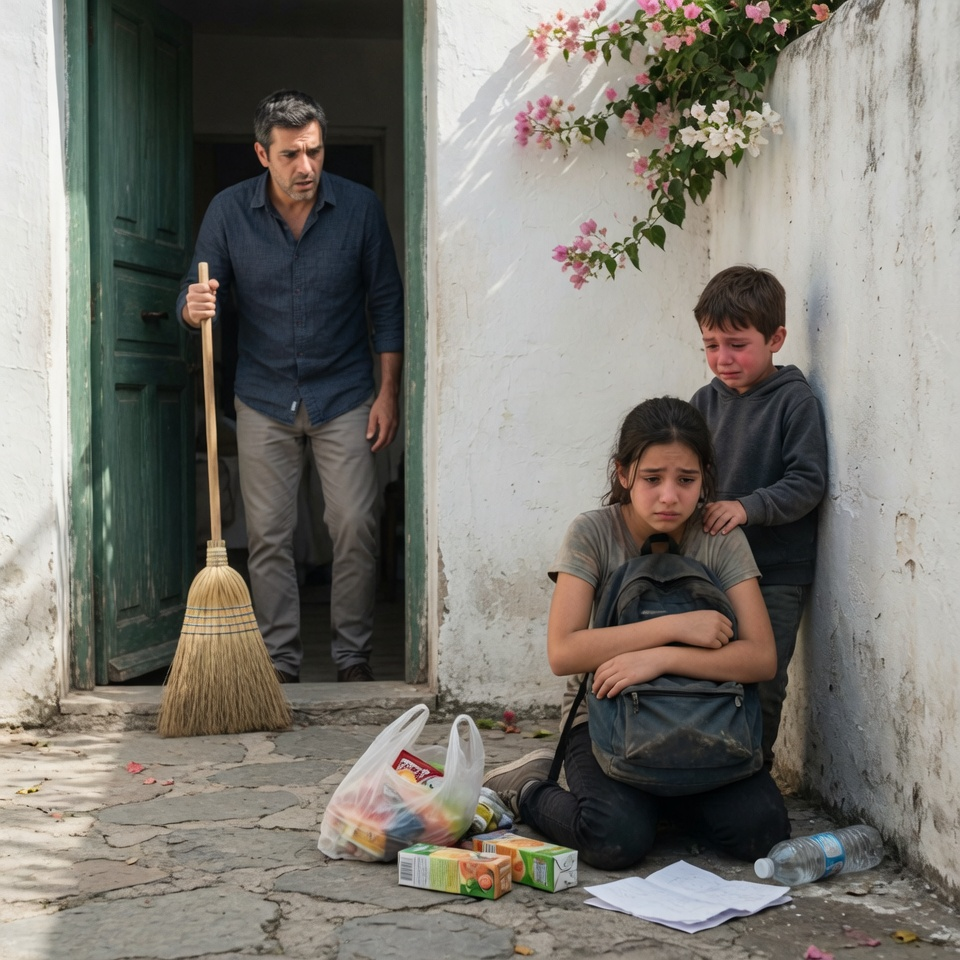
I took a broomstick and opened the patio door.
There they were.
My eleven-year-old niece Camila sat on the floor with a backpack clutched to her chest, and her eight-year-old brother Mateo stood by the fence, his eyes swollen from crying. They were both wearing sweatshirts even though it was hot. Next to them was a bag of cookies, two squashed juice boxes, a nearly empty water bottle, and the note, carefully folded, as if that were the most important thing.
I hadn’t seen Camila and Mateo for years.
My sister Veronica had made it her mission to keep me away from everything. She was always like that: the favorite daughter, the one who never asked permission, the one who threw tantrums and always got her way. My parents raised her as if the world owed her an apology for existing. I grew up in her shadow, understanding from a young age that in that house there were rules for me and excuses for her.
I left as soon as I could.
At twenty, I rented a room in Narvarte and started from scratch. I cut off contact with my parents for a long time, and my relationship with Verónica was practically nonexistent. I knew, from family gossip, that she had married, that she had been widowed young, and that she had three children: Camila, Mateo, and Renata, the youngest.
Renata was Veronica’s jewel.
The girl who competed in pageants, wore expensive dresses, posed for photos with crowns, enormous bows, and rehearsed smiles. Verónica uploaded everything to Facebook: “my princess,” “my queen,” “my pride.” She almost never showed Camila and Mateo. When they did appear, they were in the background, only partially cropped, or carrying bags.
That day I understood why.
“Uncle Luis…” Camila said in such a small voice that it broke something inside me. “My mom said to wait here.”
Mateo didn’t speak. He just pressed his lips together, as if he were afraid that any words would make things worse.
I let them in right away. I served them water, heated up some soup, made quesadillas, and tried not to show my anger. Camila ate slowly, staring at the door. Mateo asked permission to have seconds, as if eating another tortilla were a crime.
“You can eat whatever you want, Mateo,” I told him.
He looked at me suspiciously.
—Won’t my mom get angry?
I didn’t know what to answer.
I read the entire note when the two of them were sitting in the living room.
Verónica said that she and Renata were going to Cancún for a month because the girl had won a children’s pageant and “deserved a break from so much pressure.” According to her, Camila and Mateo had nothing to do on a “pretty girls’ trip,” and it would be good for them to spend time with me “so that I could finally do something useful for the family.”
He didn’t leave an exact address. He didn’t leave a hotel. He didn’t leave enough money. He didn’t ask for permission.
He just left them.
In my backyard.
As if they were two packages I could order without warning.
I tried calling her. Once. Twice. Ten times. Her cell phone went straight to voicemail. Camila had an old phone with a contact saved as “Mom,” but it was turned off too.
I called an aunt, a cousin, an old neighbor of my parents. Nobody knew anything. Some were outraged, others uttered the typical “oh, Veronica has always been like that,” as if that phrase could excuse the abandonment of two children.
So I called the police.
They told me that if the children were with me and didn’t have any visible injuries, the best thing to do was contact the Child and Adolescent Protection Unit of the DIF (National System for Integral Family Development). I felt my blood boil, but I hung up and looked up the number.
When two social workers arrived, Camila stiffened. She answered as if she were taking an exam.
—Did your mom tell you how long they were going to stay here?
-I don’t know.
Did he leave you enough food?
Camila looked at Mateo before answering.
-Yeah.
Matthew lowered his head.
The social worker, a woman named Graciela, noticed immediately.
She spoke to them separately. She reviewed the note. She took pictures of the yard. She asked how long they had been waiting. Camila confessed, almost in a whisper, that her mother had left them there in the morning and told them not to knock on the door “until their uncle arrived, because if they made a scene it would be worse.”
I felt nauseous.
That night, the DIF (National System for Integral Family Development) allowed me to keep them temporarily while they located Verónica. I accepted without hesitation. I wasn’t an expert with children. I didn’t have toys, enough beds, or any idea how to comb a girl’s hair before school. But I knew one thing: I wasn’t going to let my nephews sleep in a strange place after being abandoned like a burden.
Camila stayed in the guest room. Mateo slept on an inflatable mattress by the door because he was afraid of being alone.
Before turning off the light, he asked me:
—Uncle… is my mom coming back for us?
I looked at her little face, waiting for a pretty lie.
“I don’t know, Mateo,” I replied. “But you and your sister are safe here.”
He nodded, though he didn’t seem convinced.
At two in the morning, when I was finally starting to fall asleep, my cell phone vibrated.
It was a message from Veronica.
“You’d better not ruin my trip. Don’t exaggerate. It’s just Camila and Mateo.”
I stared at the screen, unable to believe that a mother would write that.
And she still didn’t know that, while she was happily posing on the beach with Renata, someone was already on their way to the hotel to take away the only thing that truly mattered to her…
PART 2
Verónica did not answer when DIF called her, but that did not mean they did not know how to find her.
For two days, Camila and Mateo were with me. I tried to maintain a calm routine: breakfast, television, impromptu homework, dinner. But there were things that left me speechless. Camila washed her plate without being asked, folded Mateo’s clothes, and asked if she could take a bath “so as not to waste so much water.” Mateo hid food in his sweatshirt pockets.
They were not badly behaved children.
They were children used to not getting in the way.
On Monday morning, Graciela called me. Her voice sounded serious, but also tired.
—We’ve already located your sister.
Verónica was at a resort on the Riviera Maya with Renata. Not on a simple trip, not on a whim. She had booked photo shoots, a children’s spa, dresses, expensive meals, and activities for several weeks. All paid for in advance.
When the DIF workers, supported by local authorities, arrived at the hotel, Veronica caused a scene right there at the reception.
“My children are with their uncle!” she shouted, as I was later told. “This is a family matter, not a crime!”
But the problem was the grade.
That miserable note, protected in plastic, where she herself admitted that she was leaving for a month and leaving two minors without prior agreement, without enough money and without any way to contact them.
There were also statements from Camila and Mateo.
And, above all, there was Renata.
Because, after reviewing the entire situation, the authorities decided that Renata should not remain under Verónica’s sole care while they investigated. The girl was temporarily placed in the care of her paternal grandparents: Don Ernesto and Doña Teresa, the parents of Verónica’s deceased husband.
I didn’t know them.
Verónica had always told me they were nosy, resentful people, “starving with a saint complex.” But when I spoke to Doña Teresa on the phone, I heard something I hadn’t heard in years within my family: genuine concern.
“Luis,” she told me, “we didn’t know if we could look for you. Veronica told us horrible things about you.”
-I guess so.
—He said you were a drug addict, that you had abandoned your parents, that you hated children.
I laughed humorlessly.
—Only part of it is true. Yes, I did leave that house. The rest is not.
Doña Teresa sighed.
She told me that her son, before he died, had argued many times with Verónica about the way she treated the children. He didn’t like that Renata lived a life of pageants, makeup, and crowns. Much less did he like that Camila and Mateo were ignored.
—My son said that Renata didn’t need to be queen of anything—Doña Teresa said, her voice breaking. —She needed to be a child.
After her husband’s death, Verónica shut the door on her husband’s paternal grandparents. She reduced their visits, changed schedules, and made up excuses. They tried to reach out, but she accused them of wanting to take her children away from her.
Now everything was coming to light.
When Veronica returned from Cancun, the first thing she did was not ask about Camila or Mateo.
He sent me audio messages.
Many.
“You’re a damn envious person.”
“You always wanted to see me fall.”
“How dare you hand my Renata over to those people?”
“Camila and Mateo were fine with you, don’t be so dramatic.”
I listened to the first three and then stopped opening them. I just kept them for the record.
Camila didn’t ask about her mother. Neither did Mateo. But when I told them that Renata was with her grandparents, they both looked at each other with a strange mixture of relief and fear.
“Is my mom angry?” Camila asked.
“Yes,” I answered honestly. “But that’s not your fault.”
Camila lowered her gaze.
“It’s always someone’s fault. If Renata cries, it’s my fault. If Mateo makes noise, it’s my fault. If Mom gets tired, that’s my fault too.”
I ran out of breath.
That weekend I met Don Ernesto and Doña Teresa in person. They were younger than I imagined, simple people, with a spacious house in Toluca, a well-kept garden, and three bedrooms ready for them. Not just one nice room for Renata and mattresses for the others. Three bedrooms.
Camila chose curtains with leaf designs. Mateo ran straight to a box of balls and toy cars. Renata, at first, clung to Doña Teresa’s skirt, confused, as if she didn’t understand why no one was applauding her.
The brothers’ reunion was silent.
Renata looked at Camila.
—Mom said that you guys made them take away our vacation.
Camila clenched her fists.
Mateo took a step back.
I thought Camila was going to yell at him. But she only said:
—He left us in a courtyard, Renata.
The girl remained silent.
For the first time, perhaps, that phrase entered Veronica’s head unfiltered.
The following weeks were intense. Interviews with neighbors, schools, family members. Psychological evaluations. Reports. Supervised visits for Veronica.
And each visit was worse.
She arrived with gifts for Renata: expensive dolls, dresses, headbands. For Camila, she brought a cheap notebook. For Mateo, nothing, “because children break everything.” The supervisors took notes. Doña Teresa watched. Don Ernesto clenched his jaw.
“My queen, you know that Mom loves you more than anyone,” Veronica told Renata in front of everyone. “Don’t let them fill your head with nonsense.”
Renata started to cry.
Camila got up and left the room.
Matthew followed her.
Veronica didn’t even turn to look at them.
The turning point came on the third visit.
According to the report, Verónica waited for a moment of confusion. She took Renata’s hand and walked toward the door.
—Let’s go, my love. You don’t have to be here if you want to be with Mom.
Doña Teresa intervened.
The supervisor asked him to let go of the girl.
Veronica started screaming.
—She’s my daughter! My daughter! Nobody can stop me from taking my daughter!
Renata was crying. Camila was yelling from the hallway for him to leave her alone. Mateo hid behind Don Ernesto.
The visit ended with police at the door and Veronica outside the house, still shouting that everyone was going to pay.
That night Graciela called me.
—Luis, this changes everything.
I already knew that.
Because Verónica had just shown, in front of everyone, that she did not want to get her three children back.
He just wanted to get his crown back.
And what the judge was about to decide would destroy the last lie he had left…
PART 3
The audience wasn’t like in the movies.
There was no dramatic scream, no one banging on the table, no confession with background music. It was worse. It was cold. Orderly. Legal. Every word fell like a stone.
Verónica arrived wearing makeup, dark glasses, and carrying a folder full of papers that, according to her, proved a conspiracy. She said I always hated her. That the paternal grandparents wanted to keep the children’s pension. That the DIF (Family Services) had exaggerated. That a mother has the right to rest.
When I heard that, I had to look at the floor.
A mother has the right to rest.
Of course.
But not leaving two children in someone else’s yard as if they were old furniture.
The report was damning. Temporary abandonment. Lack of an agreed-upon care network. Extreme favoritism. Emotional neglect. An attempt to remove Renata without authorization during a supervised visit. School testimonies confirming that Camila often arrived without school supplies, while Renata missed classes due to competitions. Neighbors who had heard Verónica say that “the older ones were already taking care of themselves.” Family members who admitted that no one was surprised when they learned what had happened.
Doña Teresa wept silently.
Don Ernesto did not let go of her hand.
I reported what I had experienced: the courtyard, the note, the hungry children, Mateo asking permission to eat, Camila acting like an adult at eleven years old.
Veronica glared at me with hatred.
But when she was asked directly about Camila and Mateo, she made the mistake that ultimately sank her.
“I knew Luis could take care of them,” she said. “Besides, they didn’t need that trip. It was important for Renata.”
The judge looked up.
—More important than ensuring the care of your other two children?
Veronica opened her mouth, but couldn’t find a decent-sounding answer.
Primary custody was granted to the paternal grandparents. The three children would live together with Don Ernesto and Doña Teresa. They would have authority over school, medical, and therapeutic decisions. Verónica’s visits were suspended until further notice. To resume any contact, she would have to undergo evaluations, therapy, parenting courses, and demonstrate stability.
It was not a quick punishment.
It was a closed door with many locks.
Veronica stormed out. She said she was going to appeal, that she was going to expose everyone, that I had destroyed her family.
I didn’t answer him.
Because, for the first time, she didn’t have my parents to defend her. She had no one justifying her cruelty as “strong character.” She had no applause. She had no crown.
It only had the consequences.
The following months were strange, but also beautiful.
Camila started drawing again. At first, she made small strokes, as if afraid of taking up too much space. Then she began filling entire sheets of paper with houses, trees, dogs, faces. Doña Teresa enrolled her in art classes, and the first time she won a school award, there was no expensive dress or photo shoot. There was chocolate cake, hugs, and a simple phrase:
—We are proud of you.
Camila cried more about that than about the diploma.
Mateo started playing soccer. Then basketball. Later he wanted to learn how to fix things with Don Ernesto. Every time I went to visit them, he would show me something new: a shelf, a bicycle that had been adjusted, a plant he had planted.
—Look, man, now I know how to use tools.
Renata was the most delicate process.
She missed Veronica. Sometimes she asked if her mom was sad. Sometimes she got angry because she didn’t receive more presents than her siblings. On her seventh birthday, there was a difficult moment: she expected a princess party, a huge dress, and a photographer. Her grandparents made a nice meal, with her school friends, a piñata, and ordinary presents.
Renata frowned.
-Nothing else?
The silence fell heavily.
Camila looked at her fearfully, as if expecting her usual tantrum. Mateo stopped eating.
Doña Teresa knelt in front of Renata.
—My love, here nobody is worth more for having more gifts. We love you just as much as your siblings. That’s not a small thing. That’s all.
Renata started to cry.
Not from anger. From confusion.
That day I understood that I was a victim too. Verónica hadn’t only hurt Camila and Mateo by ignoring them. She had also hurt Renata by teaching her that love was measured in crowns, dresses, and favoritism.
Therapy helped.
Time too.
The relationship between the three siblings began to resemble a normal one: fights over toys, silly laughter, arguments over television, reconciliations with cookies. Nothing perfect. But real.
I continued visiting them. Sometimes they came to my house on weekends. I gave the grandparents a copy of my key, not because it was necessary, but because I could never again bear the thought of a child waiting outside my door.
Verónica, meanwhile, faded from the process.
At first she threatened lawsuits. Then she stopped going to the evaluations. Then she changed lawyers. Then she didn’t have a lawyer anymore. We learned from family members that she was seeing different men, that she said she wanted to “start over” and have another daughter, one that no one could take away from her.
That phrase gave me chills.
Not because I cared what Veronica did with her life, but because I understood that, for her, her children were never whole people. They were extensions of her ego. When they stopped being useful to her, she lost interest.
The family eventually turned their backs on her. Some took a while, others didn’t. But when they saw the reports, the messages, the note, no one could keep saying, “It’s because she’s his mother.”
Being a mother doesn’t make you innocent.
Being a mother doesn’t give you permission to break your children and then demand that they be returned to you because you gave birth to them.
Years later, Camila is a confident, strong-willed teenager, the kind who no longer lowers her gaze when she asks for something. Mateo is a wonderful whirlwind, full of friends, sports, and questions. Renata no longer competes in contests. Sometimes she sings, sometimes she paints, sometimes she plays soccer with Mateo, even though she says she doesn’t like it.
All three are still healing.
At their own pace.
With stumbles.
With equal love.
And I, who always thought I had escaped from my family never to return, ended up understanding something: sometimes one does not return to save the adults who hurt them, but to open the door to the children who can still be saved.
Veronica left two children in my yard believing they were a burden.
But that afternoon, without knowing it, he also left the evidence that unmasked him.
And the saddest thing is that, when she lost her three children, she didn’t cry for the harm she did to them.
She cried because, for the first time in her life, nobody rushed to agree with her.