PART 1
—Did you really bring that to my house? It smells like an old inn, Doña Carmen.
My daughter-in-law, Valeria, said those words in front of twelve people, with a glass of white wine in her hand and a smile so pure it was frightening. I was standing in the middle of the room, carrying an earthenware casserole dish wrapped in an embroidered tablecloth, still warm, still smelling of love.
My name is Carmen Méndez, I am seventy-one years old, and for thirty-eight years I owned a small restaurant in the Guerrero neighborhood of Mexico City. I sold stuffed chiles, red rice, mole de olla, and green enchiladas from before my son Daniel could even walk. With those hands, stained with oil and life, I paid for his schooling, his law degree, his expensive suits, and even the apartment where he lives today with his wife.
But that afternoon I understood something that broke my heart: you can feed a child for a lifetime and still see him sit in silence while someone spits on his mother’s table.
It was Sunday. I had gotten up at five in the morning to prepare cochinita pibil, rice, black beans, and freshly made tortillas. Daniel had loved that food since he was a child. When he was little, he would tell me, “Mom, when I grow up rich, I’m going to eat this every day.” I would laugh and wipe his mouth with the corner of my apron.
Now Daniel lived in a stylish apartment in Del Valle, with gray furniture, abstract paintings, and a kitchen that looked like it belonged in a magazine, but where nobody cooked. Valeria was a wellness influencer, one of those who talked about energy, detox, and self-love, but couldn’t look at an older woman without wrinkling their noses.
When I arrived, the doorman greeted me warmly.
—Doña Carmen, are you bringing delicious food again?
—Just a little bit, Don Julián. Let’s see if they’ll let me sit down and eat with them now.
He lowered his gaze. He said nothing, but his silence warned me of what I didn’t want to accept.
I rang the doorbell. Daniel opened the door. He was nervous.
—Mom… didn’t you say you were coming back in the afternoon?
—I told you I was coming for lunch, son. I brought your pork.
Before I could answer, Valeria appeared wearing a beige dress and with perfectly straightened hair.
—Oh, Doña Carmen… what a surprise.
It wasn’t a surprise. It was annoying.
I went inside and saw his friends sitting in the living room, all with glasses, laughing quietly. There were trays with cheeses, fruits, and tiny crackers that looked like bird food. I put my casserole dish on the table.
—It’s nice and warm. I made it the way Daniel likes it.
Valeria approached quickly.
—No, no, no. This doesn’t belong here.
—What do you mean it’s not going?
—My guests don’t eat fat, Doña Carmen. Here we’re careful about what we put into our bodies.
Some people laughed. Daniel looked at the floor.
—Daughter, it’s not just any old thing. It took me hours.
Valeria lifted the lid. The aroma filled the room. To me, it smelled like Sunday, like family, like home. To her, it seemed to smell like shame.
“This is heavy food. Food for people who don’t understand health. Excuse me, but I don’t want my house to smell like a market.”
My house. That’s what he said. My house.
The word stung me like a thorn, because that apartment wasn’t hers. Nor Daniel’s. It was mine. I bought it outright when I sold my small kitchen. I put it in my name on the advice of my lawyer, Don Ernesto, although I let them live there rent-free. Daniel told me that way they could save money. Valeria hugged me that day and called me “the best mother-in-law in the world.”
But of course, back then I was useful.
“Valeria, don’t talk like that,” I murmured, still trying not to lose my composure.
She burst out laughing.
—Oh, Doña Carmen, don’t be offended. But understand: Daniel is no longer the little boy who ate at your little restaurant. He’s on another level now.
I looked at my son. I waited for a word. Just one. For him to say, “Respect my mom.” For him to say, “That food reminds me of where I come from.” For him to say something.
But Daniel said nothing.
Valeria took the saucepan with both hands and walked towards the kitchen.
“No, Valeria,” I said, taking a step. “Don’t do that.”
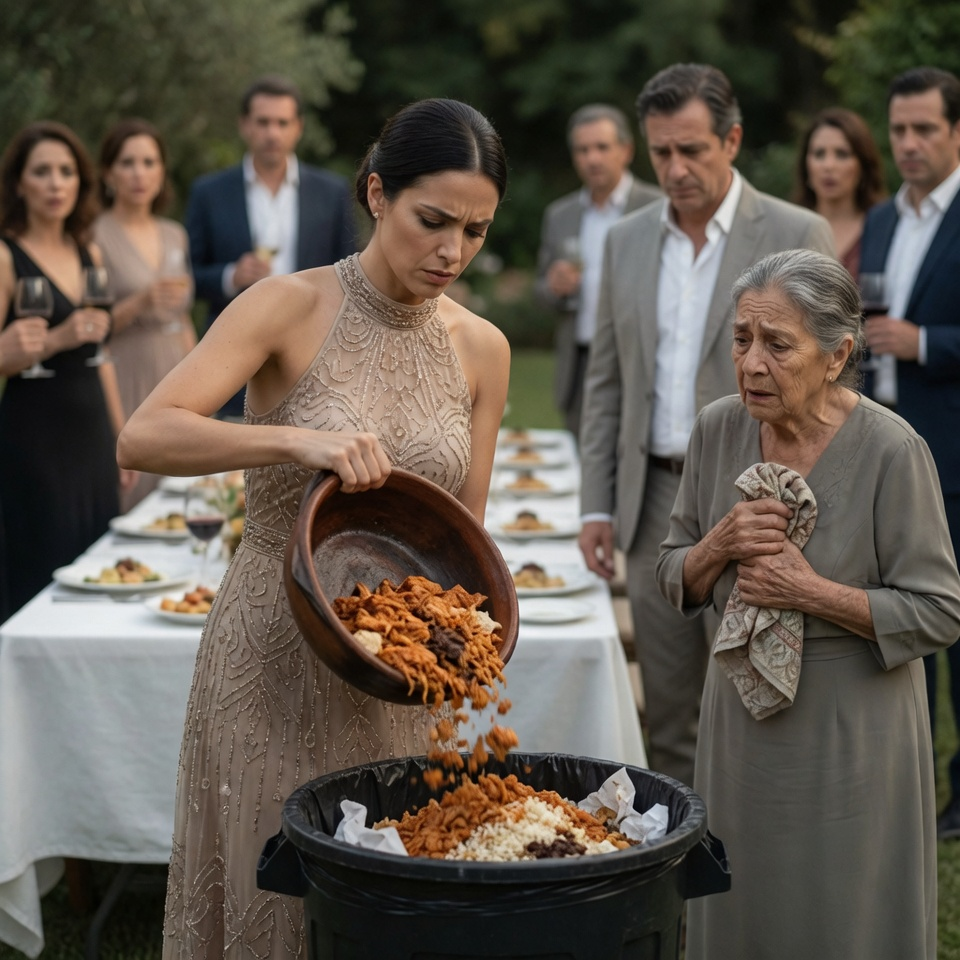
She opened the automatic trash can. The lid lifted as if it too obeyed her pride.
—This is done with things that don’t fit into our lives.
And he turned the pot upside down.
I saw the cochinita pibil, the rice, the beans fall. I saw my early morning, my effort, my love, all mixed with dirty napkins and fruit peels. The sound was wet, horrible, like a slap.
Nobody spoke.
Valeria put the empty saucepan in the sink and washed her hands.
—Okay. Now we can breathe.
I felt something break inside me. I didn’t cry. I didn’t scream. I just stared at Daniel.
—Mom… Valeria got upset. We’ll talk later.
I grabbed my bag.
—No, son. They’ve talked enough.
I walked towards the door. Before leaving, I heard Valeria say:
—What a tragedy. That’s why you can’t invite ordinary families.
Then I knew I wasn’t going back to that house with food.
Next time I’ll come back with papers.
And they still couldn’t imagine what they had just awakened.
PART 2
I didn’t cry in the taxi. Nor did I cry when I arrived home in the Portales neighborhood, that old house with flowerpots at the entrance, tiled floors, and the smell of freshly brewed coffee. Crying would have clogged my nose, and I needed to breathe properly to think.
I sat down in the kitchen, my real office. There I had signed orders, counted coins, calculated payroll, and decided my son’s future many times without him even knowing. The kitchen wasn’t a small place for me. It was the place where an uneducated woman had built a fortune.
I put water on to boil. As the steam rose, I looked at my hands. They were thick hands, with small knife scars, burn marks, and short nails. Valeria had soft hands, white nails, fingers adorned with expensive rings. She had never cleaned a grease-covered iron at the end of the day. She had never carried sacks of rice to save on freight. She had never seen her son fall asleep in a chair while she finished washing dishes.
But he lived under a roof he had bought with his own hands.
When Daniel was six, his father left. He didn’t die, life didn’t abandon him; he simply grew tired of being responsible. I was left with a child, debt, and a small kitchen that barely made enough to pay the electricity bill. Everyone told me to close it down. That a single woman couldn’t do it. That I should find work cleaning houses.
I didn’t close.
I would get up at four. I would go to the Central de Abasto (wholesale market). I would prepare food for laborers, secretaries, taxi drivers, and students. Daniel grew up surrounded by pots and plastic tables. He studied with the smell of beef broth on his clothes. I always told him:
—Don’t be ashamed, son. This smell comes from honest work.
He nodded. As a child, he understood.
He forgot about it as an adult.
I opened my bedroom closet and took out a reinforced cardboard box, hidden under some blankets. Inside I kept documents: deeds, receipts, property tax payments, old contracts, photographs. I looked for the blue folder.
There it was.
Public deed of the apartment. Owner: Carmen Méndez Ríos. Marital status: widow. Occupation: merchant.
I ran my fingers over my name. Never had a signature seemed so beautiful to me.
Then I got the receipts. Property tax. Maintenance. Special assessments. Elevator repair. Valeria’s car insurance, because Daniel asked me to put it in my name so it would be cheaper. An additional credit card I had given him “for emergencies.”
Emergencies, yes. Japanese restaurants, spas, wines, designer clothes.
I started adding.
Almost two hundred and twenty thousand pesos in five years, not counting the value of the apartment.
I laughed to myself. A dry, bitter laugh.
—Ordinary food, right? They didn’t get their money for ordinary food.
I picked up my cell phone. I had fifteen messages from Daniel.
“Mom, answer me.”
“Don’t exaggerate.”
“Valeria didn’t mean to offend you.”
“We’ll make it up to you later.”
“Don’t make a scene.”
I didn’t answer.
Then another message came in. It was from Valeria.
“Doña Carmen, I sent you a box of macarons to help you get over your disappointment. They’re lighter than what you brought. Kisses.”
Five minutes later there was a knock at the door. It was a delivery man with a stylish bag. I opened the box. Colorful cookies, arranged like jewels. The note read: “To sweeten the night and boost your energy.”
I threw the whole thing in the trash.
Not because I don’t like sweets. But because I don’t accept apologies that still carry contempt wrapped in cellophane.
I looked up the number of Don Ernesto, my lifelong lawyer.
—Carmencita, is everything alright?
—No, sir. Everything’s just about to get better. I need a notice to vacate.
There was silence.
—From Daniel’s department?
—From my apartment where Daniel lives.
—He’s your son.
—And I am his mother, not his doormat.
Don Ernesto sighed.
—We can terminate the verbal loan agreement. Give thirty days. It’s your right.
—That’s what I want. And tomorrow I’ll cancel all automatic payments.
—Carmen, this is going to break up the family.
I looked at my kitchen. My table. My hanging pots. My whole life.
—No, sir. The family broke up when they threw my food in the trash and my son stayed silent.
The next day I went to the bank. I canceled the maintenance payment, the car insurance, the additional card, and any other charges that benefited Daniel. The manager looked at me in surprise.
—Are you sure, Doña Carmen?
—Absolutely. The free restaurant is closed.
Then I went to the apartment. I had a key. It was my property. Daniel and Valeria weren’t there. The doorman, Don Julián, let me in.
“Doña Carmen, they crossed the line yesterday,” he said quietly. “That lady treats us badly too. She says we smell like the street.”
—Well, soon you’ll even miss the smell of the elevator, Don Julián.
I went inside. The room was a mess, with dirty glasses and discarded napkins. In the sink, I found my casserole dish. Half-washed, as if it too had been humiliated. I picked it up and put it in my bag.
Then I saw something on the bar: an interior design folder.
“Main dressing room expansion project.”
I opened it.
They were planning to knock down the wall of the guest room. My room. The room where I slept when I went to take care of sick Daniel. The only corner I considered mine in that apartment. They were going to turn it into a closet for bags, shoes, and a nice backdrop for Valeria’s live streams.
There was an initial budget of thirty-five thousand pesos.
And a note written by Daniel: “Ask Mom for a property improvement.”
I felt cold.
It wasn’t just that they despised me. It was that they wanted to erase my place and charge me for the demolition.
I closed the folder.
That’s when I understood that the shame wasn’t mine.
And Daniel’s next call wasn’t going to find his mother crying, but the owner waiting with the deed in her hand.
PART 3
My phone rang on Tuesday at ten o’clock in the morning.
I was pouring coffee into a white cup when I saw Daniel’s name on the screen. I let it ring three times. On the fourth time, I answered.
—Good morning, son.
“Good morning? What did you do, Mom? A document arrived from the notary! It says we have thirty days to leave. Are you crazy?”
I stared at the coffee. Black, strong, just as it should be that day.
—I’m not crazy, Daniel. I’m just remembering that the apartment is mine.
In the background, Valeria’s voice could be heard shouting.
—Give me the phone!
Then his voice pierced my ear.
—Doña Carmen, this is ridiculous. You can’t kick us out. We’re family. Besides, what will people say? I have a public image.
—The same people who saw you throw my food in the trash can find out that you were also living rent-free in my apartment.
She remained silent for a second.
—You’re sick. This is emotional abuse. I’m going to sue you.
—Go ahead and file the lawsuit. Bring the deed. My name is on it.
—Come right now.
—I’m going because I want to, not because you tell me to.
I dressed in my navy blue suit, the one I wore for important business. I put away the deed, the receipts, and the dressing room project folder. I took a taxi. That day I didn’t want to arrive as a guest. I wanted to arrive as the owner.
When I went upstairs, Daniel opened the door. He was pale, with swollen eyes. Valeria was pacing back and forth, talking on her cell phone to someone who, apparently, wasn’t giving her the answer she wanted.
—Yes, but there has to be a way… she’s an elderly lady… maybe she doesn’t know what she’s signing…
I entered without asking permission.
—I know very well what I’m signing, Valeria. That’s why you lived five years where you lived.
She hung up.
—This is revenge over a casserole dish.
—No. The casserole was the final straw. The disrespect started long before that.
I put the documents on the table.
Property tax. Maintenance. Special assessments. Car insurance. Additional card. Do you want me to continue?
Daniel lowered his head.
—Mom, I was going to pay you later.
—After what? After they finished using me?
Valeria crossed her arms.
—You have money. It doesn’t cost you anything to help your son.
—Of course it’s hard for me. It cost me early mornings, varicose veins, burns, years without vacations. It cost me my back and my youth. And I didn’t work my whole life to maintain the stage for your videos.
Valeria blushed.
—You’ve always been envious of us. It bothers you that we live better than you.
—No, daughter. It bothers me that they live better than me with my money and on top of that they treat me like a servant.
Daniel cried silently.
—Mom, forgive me. I didn’t know about the closet.
I took out the project folder and placed it in front of him.
—But you signed here.
She opened it. Her hands trembled.
—Valeria, you told me they were only going to change the furniture.
She looked away.
—It was an improvement. That room is hardly ever used.
I stared at her.
“That room was my place. The only space where I still thought I had a place in my son’s life. And you were going to tear it down to store shoes. With my money.”
Daniel covered his face.
—Sorry, Mom.
—Forgiveness does not restore dignity if it does not come with consequences.
I kept the papers.
—You have thirty days. Starting today, I’m not paying anything else. Not maintenance, not insurance, not credit card, not any frivolous things. If you want to live like adults, start by paying like adults.
Valeria lost control.
—You bitter old woman! She’s going to be all alone! Nobody will take care of her when she’s sick.
I felt the blow, but I didn’t bend.
—I prefer to grow old alone in my house, with my cooking pot on the table, than to grow old surrounded by people waiting for me to die so they can take what they didn’t build.
Daniel got up.
-Mother…
—The extra key.
He went to the kitchen, took the key from the hook, and handed it to me. His fingers brushed against mine. I felt my inner child there, hidden behind the cowardly man he had become.
—You have thirty days to learn something, Daniel. I hope it’s not too late.
I left.
A month later they handed over the apartment. No apology. No letter. They left the keys at the front desk. When I walked in, I found lamps ripped out, dirty walls, and even the toilet seats missing. Valeria had taken what she could, but she couldn’t take the most important thing: the roof.
I painted the apartment and rented it out. With that money, I started a cooking workshop for unemployed women in a community center in the neighborhood. I called it “Sazón de Madre” (Mother’s Seasoning). I taught them how to make stews, how to calculate costs, and how to sell food without giving away their labor. Many arrived believing that cooking was insignificant. I told them from the first day:
—Cooking is not humiliation. Cooking is power when money falls into your hands.
Six months later, Daniel knocked on my door.
He was thinner, without a car, and his suit was wrinkled.
—Mom, Valeria left.
—I already knew that.
—He told me that I wasn’t the man I pretended to be.
—For the first time, he didn’t lie.
He sat down in my living room and cried. I served him coffee and sweet bread. I didn’t hug him right away. Some tears need to fall on their own to cleanse properly.
“Can I come back and live here for a while?” he asked.
I looked at him with love, but also with memory.
—No, Daniel.
It hurt her. It hurt me too.
“If you come back under my roof, you’ll never learn to support your own. You can come for Sunday lunch. You can ask me for advice. But not money or a house.”
He lowered his head.
—Will you make cochinita?
—With beans, rice, and tortillas. And if the smell embarrasses you, don’t come.
He smiled through his tears.
—I was never ashamed, Mom. I was just an idiot.
—Then start by ceasing to be one.
Today, my clay pot sits at the center of my table every Sunday. Daniel arrives early, chops onions, warms tortillas, and washes the dishes. He never called me dramatic again. He never stayed silent again when someone disrespected me.
I still live in my house, with my plants, my coffee, and my keys in my hand.
I learned late, but I learned well: a mother can love without letting herself be trampled on. Old age is not weakness. Food made with tired hands is not shameful. And he who despises the root that gave him shade will one day be left under the sun, without a roof and without a table.
Because this house is mine, this life is mine, and no one will ever throw my dignity in the trash again at my table.